13 Small Balcony Ideas for Apartments That Prove Size Is Just a Number
Your balcony is tiny. Your standards don’t have to be.
There is a particular frustration unique to apartment living: the small balcony. Not a terrace. Not a rooftop. Just a narrow strip of outdoor space that’s technically outside but mostly functions as a place to store the bike you swore you’d use more and a box of things you haven’t unpacked since you moved in.
Here’s the reframe: small doesn’t mean sad. Some of the most beautifully designed outdoor spaces in the world are compact. Japanese courtyard gardens. Parisian juliet balconies. That one café in your neighborhood with four tables on the sidewalk that always has a line. Small is a design constraint, and design constraints, when you lean into them, produce better results than blank-slate abundance.
So. Your apartment balcony is small. Let’s make it exceptional.
1. Stop Thinking “Patio” and Start Thinking “Room”
The single biggest mental shift that improves small balconies: treat the space like an interior room, not a leftover exterior ledge. Rooms have defined zones, intentional furniture, layered lighting, and a reason to be there. Ledges have whatever didn’t fit inside.
When you approach your balcony with the same design thinking you’d apply to a living room corner, everything changes. You stop trying to cram a full outdoor dining set in and start asking: what does this space need to be one specific, great thing? A reading nook. A morning coffee spot. A dining-for-two setup. Pick one function, design for it entirely, and the small square footage stops being a limitation.
2. Ditch the Big Table, Get a Bistro Set
A full outdoor dining table on a small apartment balcony is like wearing a winter coat in a studio apartment — technically possible, functionally miserable. A bistro set — two small chairs and a round table sized for two — is the proportionally correct answer. It gives you a surface and seating without consuming the entire footprint. The classics (Fermob Luxembourg, or any number of honest knockoffs) fold flat against a wall when not in use, buying back square footage in an instant.
3. Maximize Vertical Space Like Your Floor Plan Depends On It
Because it does. When floor space is limited, the wall is your best friend. Wall-mounted planters in a vertical column. A pegboard system with hooks for tools, small pots, and accessories. Floating shelves at varying heights for plants and candles and a small speaker. A trellis structure that frames the space and gives climbing plants somewhere to go.
Every inch of wall you activate is an inch of floor you liberate. Think upward. The balcony ceiling is farther away than you think.
4. Use Furniture That Does Two Jobs
In a small balcony, multifunctional furniture isn’t a nice-to-have, it’s the strategy. An ottoman with internal storage that also serves as a footrest and an extra seat when needed. A bench with a hinged lid. A side table that folds flat when company isn’t over. Look for pieces explicitly designed for small spaces — the outdoor furniture market has responded to apartment living in a real way, and there are genuinely clever options at most price points.
The goal is to have everything you need and nothing you don’t, without sacrificing either.
5. Create the Illusion of Width With a Horizontal Stripe
Design trick borrowed directly from interior design: horizontal lines make spaces feel wider. On a small balcony, this means a horizontally slatted railing screen, a striped outdoor rug with the stripes running perpendicular to the longest wall, or deck tiles laid in a horizontal pattern. None of these things actually change the dimensions of your balcony. They just change what your eye perceives. And perception, in design, is about 80% of reality.
6. Keep the Railing View Open
This one goes against the instinct to screen everything for privacy, but hear it out. On a small balcony, blocking the view beyond the railing shrinks the perceived space dramatically. Glass railings, open metal railings, or sheer outdoor curtain panels that move in the breeze all maintain the visual connection to the space beyond your balcony — the street, the sky, the trees — and borrow that depth optically.
If you need privacy from neighbors above or to the side, screen those specific angles. Leave the outward view open. Your balcony will feel twice as large.
7. Plant in Proportion
There’s a common small balcony mistake: buying many small plants because they take up less space individually. The effect is visual noise — a scattered collection of mismatched pots that reads as clutter, not greenery. The better move is fewer plants, intentionally sized and placed.
Two medium-sized plants flanking the door. One tall statement plant in the corner. A single trailing plant hanging from the ceiling. The discipline of editing is what makes small spaces feel curated rather than cramped. Give each plant room to be noticed.
8. Get the Lighting Right (It’s Doing More Work Than You Think)
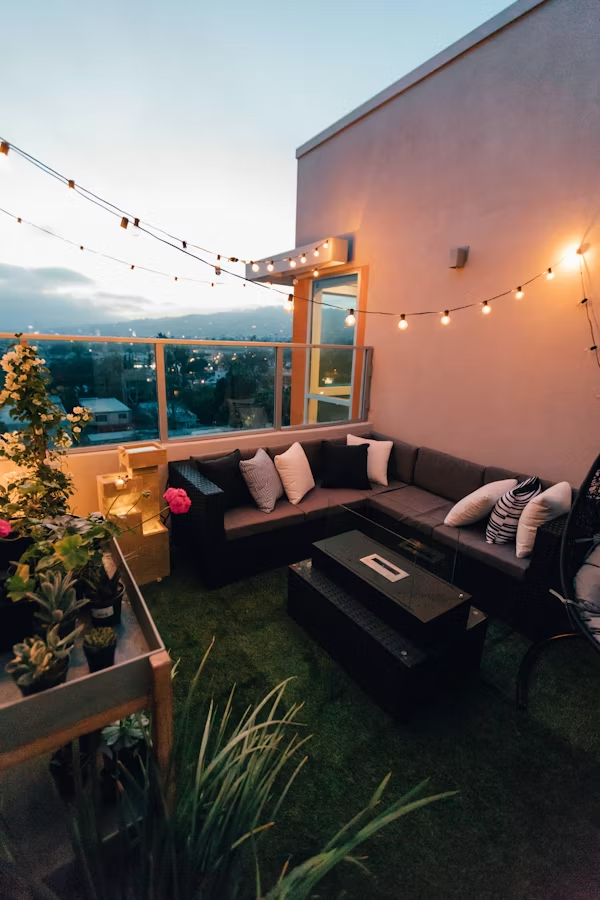
Small spaces feel dramatically different in the evening depending on light quality. A single overhead balcony light — usually a harsh utility fixture — does nothing good for atmosphere. Layer in: a string of warm Edison bulbs along the ceiling perimeter, a small battery-powered lantern on the table, and optionally a solar stake light in a planter.
The result is a warm, low-level glow that makes the space feel intimate rather than cramped. Good lighting in a small space is one of those invisible interventions that people can’t name but absolutely feel.
9. Use a Mirror to Cheat the Square Footage
An outdoor-rated mirror mounted on the back wall of a small balcony does something remarkable: it doubles the perceived depth of the space. The reflection pushes the visual boundary of the balcony outward, creates the impression of a larger area, and bounces natural light around in a way that benefits both you and your plants.
Use an arched or round mirror in a weather-resistant frame. Mount it opposite the best view. The effect is immediately noticeable and consistently surprising, even to people who know exactly what you did.
10. Go Monochrome to Visually Expand the Space
Color contrast draws the eye to boundaries. When everything on your balcony — floor, furniture, cushions, planters — is in the same color family, those boundaries soften and the space feels less chopped up. An all-white balcony reads as airy and expansive. All-natural wood tones feel calm and continuous. A single matte black palette reads as intentionally editorial.
Pick one family, stick to it, and resist the urge to add an accent color “just for pop.” The restraint is the pop. The restraint IS the style.
11. Hang Things From the Ceiling
The overhead plane on most balconies is completely ignored, which is a waste. A ceiling-mounted hook opens up a world of options: a hanging chair or hammock seat that takes up zero floor space; a hanging planter that cascades downward; a set of wind chimes; a small pendant lantern. Anything you move to the ceiling is something that’s not on the floor. In a small apartment balcony, that trade is almost always worth making.
Hanging chairs in particular are transformational for small balconies. You get a full seating experience with a footprint of approximately zero.
12. Define Zones With a Rug, Even in a Tiny Space
It sounds counterintuitive — why put a rug in an already-small space? Because rugs define territory, and defined territory feels purposeful. A small outdoor rug under the bistro set signals: this is the dining area. The unrugged section beyond it becomes the “standing and looking at the view” zone by default, which is also a zone, and a good one.
The rug doesn’t need to be large. It needs to be proportional to the furniture sitting on it and large enough that the chair legs sit on it when pushed back. That’s the rule. Follow it.
13. Add One Thing That’s Purely for Pleasure
Every great small space has something in it that serves no practical function — it’s just delightful. A small chime that sounds good in the wind. A ceramic sculpture in a planter. A stack of paperbacks inside a weatherproof box. A tiny solar-powered light shaped like something you love.
Small balconies become spaces you want to inhabit when they feel personal, not just designed. The functional elements — the furniture, the rug, the plants — create the foundation. The one frivolous, specific, only-you thing is what makes it yours.
Final Thought: Edit Ruthlessly, Add Intentionally
The golden rule of small balcony design is the same as the golden rule of small space design everywhere: every object in the space should earn its place. If it’s broken, redundant, or just kind of there by default, it goes. What remains gets arranged with care.
Small apartment balconies don’t fail because they’re small. They fail because they accumulate things without intention. A few well-chosen pieces — the right chair, the right plant, the right light — turn even the most unpromising narrow strip of outdoor space into somewhere you’ll genuinely want to be.
The bike, though. The bike might have to go inside. Or at least against the wall. We’re working with what we have.