
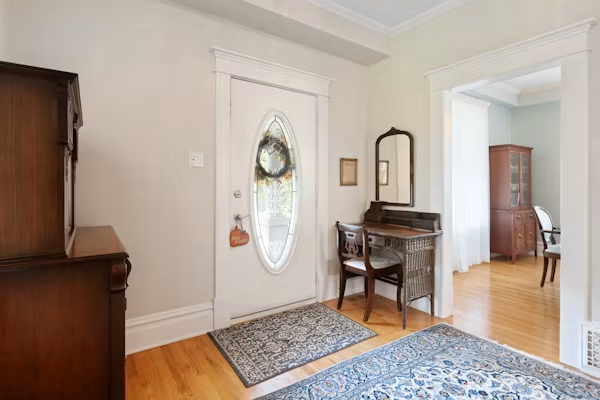
The entryway is not a hallway. It is a handshake. And yours should be firm.
There is a moment that happens in every home visit, so brief and automatic that most people don’t consciously register it. You step through the front door, and in the space of about three seconds, you form a complete impression of the home you’re entering. Not of a single room. Not of the kitchen or the living room. Of the home as a whole, its character, its warmth, its level of intention.
That impression is formed entirely in the entryway.
The front entry is the most loaded space in a home precisely because it is, in square footage terms, often the smallest. It bears the full weight of first impressions while getting a fraction of the design attention lavished on living rooms and kitchens.
People renovate their kitchens with great seriousness and then ignore the narrow corridor that everyone walks through first. It is a strange set of priorities, and it produces a strange result: homes that are beautiful in their interior rooms and strangely forgettable at their threshold.
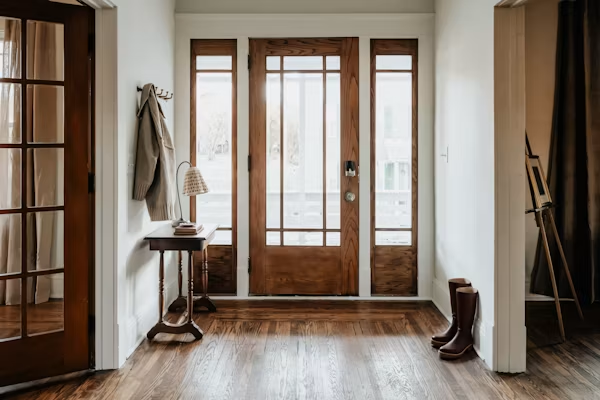
The good news is that the entryway is one of the most responsive spaces in a home to design investment. Because it is small, changes are immediately apparent. Because it is transitional, even modest improvements shift the experience of the whole house. Getting it right doesn’t require a full renovation though it can certainly accommodate one. It requires understanding what the entryway is actually supposed to do, and making deliberate choices in service of that purpose.
What the Entryway Is Actually For
Before deciding what to put in an entryway, it helps to think clearly about what the entryway needs to accomplish. It has, in fact, two distinct jobs that are easy to conflate but worth separating.
The first job is functional. The entryway is where the transition between outside and inside happens where coats come off, shoes are removed or kicked to a corner, bags are dropped, keys disappear into the void, and mail accumulates in a way that defies all organizational interventions. It needs to handle this physical reality without becoming a disaster zone. This means storage, surfaces, and systems, some place to hang things, some place to put things, some place to find things when you need them.
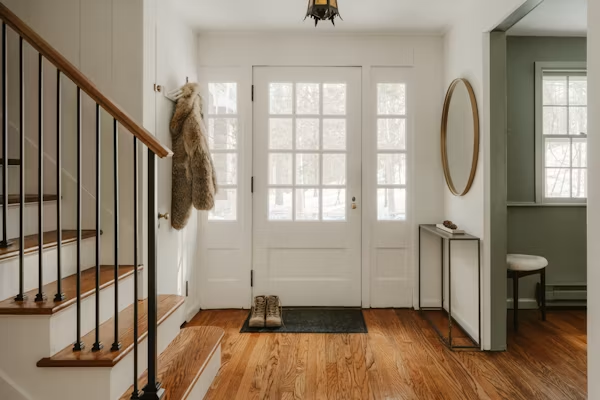
The second job is atmospheric. The entryway sets the tone for the entire home. It tells everyone who enters including the people who live there, arriving home at the end of a long day what kind of place this is. It calibrates expectations. It creates a first emotional impression that colours how every subsequent room is experienced. This job is less about storage and more about character, warmth, and visual intention.
Most entryways fail at one or both of these jobs. The ones that succeed at both are the ones that feel, from the moment the door opens, like the rest of the house was designed by the same person who cared about this corridor. That coherence is what distinguishes a great entryway from a merely functional one.
The Console Table as the Backbone of the Space
If there is a single piece of furniture that does the most comprehensive work in an entryway, it is the console table. Narrow enough to respect the limited floor space of most entry corridors, tall enough to function at standing height, and surface-providing enough to anchor everything placed near and around it as the console table is the backbone of entryway design in the way a sofa is the backbone of a living room.
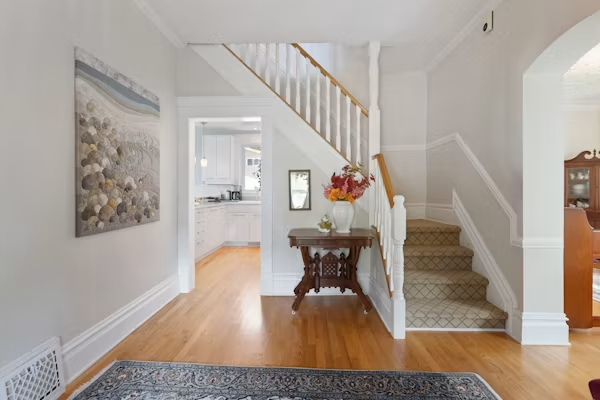
The surface of the console table is where the entryway’s character lives. A lamp, even a small one, transforms a flat surface into something that radiates warmth and presence especially in the evenings when the overhead light alone produces an institutional flatness that no entry should tolerate.
A small tray or dish corrals the keys, sunglasses, and miscellaneous objects that would otherwise migrate across the entire surface. A plant, a stack of books, a piece of art leaned against the wall rather than hung, these are the objects that make the surface feel inhabited rather than staged.
The wall above the console table is equally important. A mirror is the most reliable choice and for good reason: it bounces light, makes the space feel larger, and gives people a moment to check themselves before they walk out the door or welcome guests in.
But a piece of art, a set of framed prints in a gallery arrangement, or a large-scale photograph can do the same atmospheric work. The objective is to give the eye somewhere to go to create a focal point that makes the narrow space feel considered rather than incidental.
Related Posts:
Lighting as the Invisible Architecture
In an entryway, lighting is doing more work than it appears to. The quality of light in a transitional space like its warmth, its height or its distribution determines whether the entry feels welcoming or institutional, intimate or exposed, designed or default.
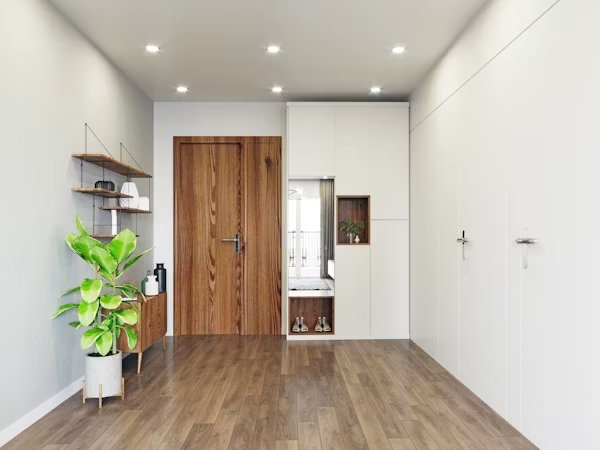
The overhead fixture is the starting point and often the problem. Builder-standard ceiling lights in flush-mount formats provide even, flat illumination that is technically adequate and aesthetically unremarkable.
The easiest upgrade available is replacing the overhead fixture with something that has character like a pendant in a warm material, a flush-mount with a distinctive silhouette, a small chandelier if the ceiling height allows it. The fixture doesn’t need to be expensive. It needs to have been chosen.
The table lamp on the console table, if present, layers in a lower, warmer light source that changes the atmosphere of the entry significantly. Lamps at eye level or below produce intimacy. Overhead light alone produces examination.
The combination of the two, overhead for orientation, table lamp for atmosphere is the same layering principle used in restaurant design to make people feel comfortable and inclined to stay. Apply it to your entryway and people will feel, without knowing why, that yours is a home they want to spend time in.
Sconces on either side of a mirror or piece of art above the console table are a third option — symmetrical, elegant, and historically consistent with the entryway’s traditional function as a place of formal welcome. They work particularly well in spaces with enough wall width to accommodate them without feeling crowded.
In all cases, warm white bulbs (2700K or lower) are the correct choice. The entryway is the first sensory experience of the home. It should be warm.
The Floor That Leads People In
The floor of an entryway is subjected to more traffic and more weather than any other surface in the home. Dirt, moisture, grit, and the full mechanical force of daily entry and exit are deposited here, reliably, several times a day. This combination of high traffic and high visibility makes the entryway floor a peculiarly important design decision.
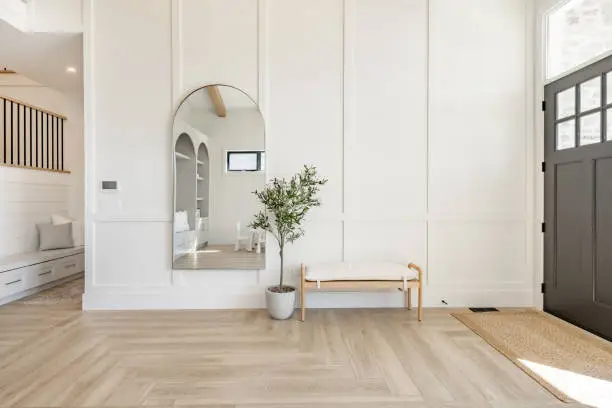
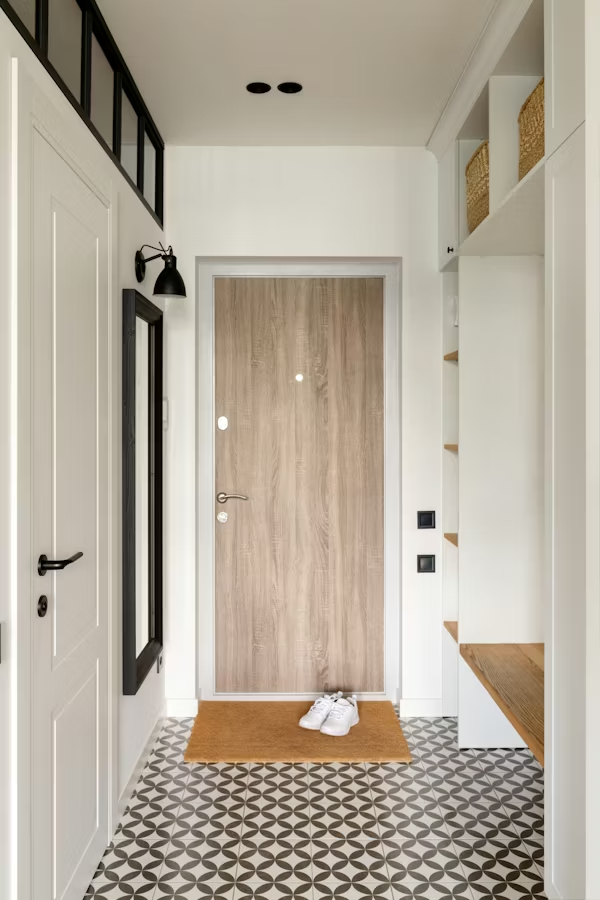
Hard flooring like tile, stone, wood, or engineered wood is the practical choice and the most common. The specific material matters less than the colour and pattern: a floor that is interesting introduces the design language of the home immediately. Patterned cement tiles, herringbone wood, a geometric stone inlay, any of these make the entryway a place worth pausing in rather than rushing through.
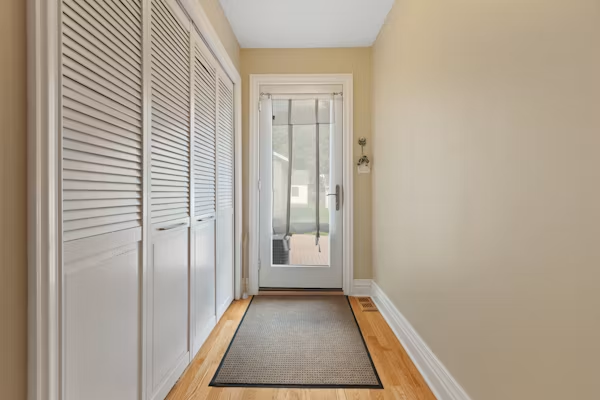
On top of the hard floor, or instead of it in a rented space where the original surface cannot be changed, a well-chosen entryway rug is the most accessible single upgrade available. It defines the space, adds warmth, and demonstrates taste in a moment.
The rug size rule that applies everywhere applies here: larger than instinct suggests, with enough coverage to feel like a decision rather than an afterthought. A runner for long, narrow entries; a more compact rectangular or round rug for square entry spaces. Natural fibre rugs like jute, sisal, wool are forgiving of high traffic and age well. Washable synthetic options handle the practical reality of muddy shoes without sacrificing softness.
Storage That Doesn’t Look Like Storage
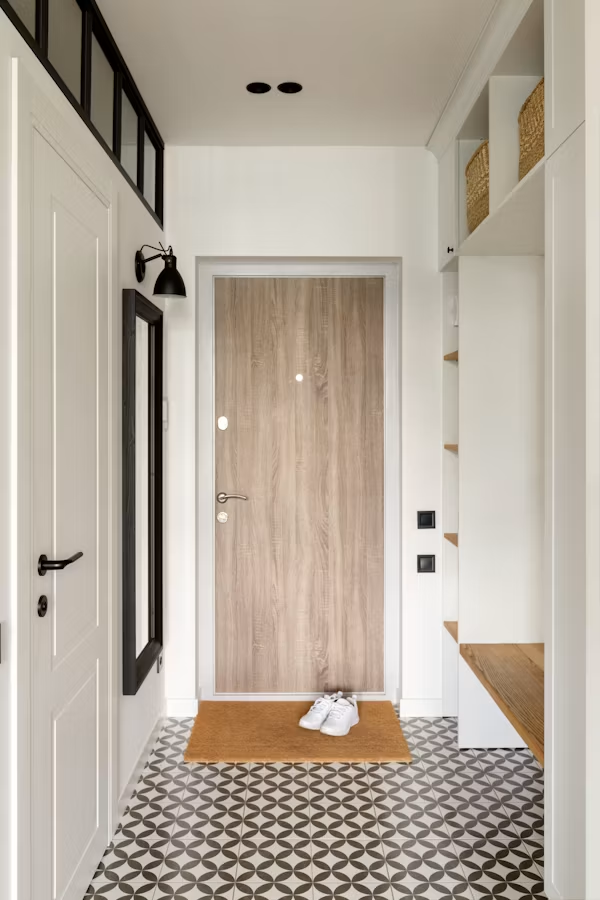
The functional demands of an entryway like somewhere for coats, shoes, bags, keys, umbrellas, and the expanding universe of objects that accumulate at the point of entry are real and not to be ignored. But the way those demands are met is the difference between an entryway that functions and one that functions beautifully.
A row of hooks on the wall, thoughtfully arranged and in a hardware finish that coordinates with everything else in the space, does more atmospheric work than a coat rack. Built-in cubbies or a narrow bench with storage below address the shoe situation without the visual chaos of footwear displayed in full. A small basket or decorative bowl near the door captures the miscellaneous objects; the keys, the lip balm, the receipts that resist all other organizational efforts.
The underlying principle is that storage in a high-design entryway should feel integrated rather than appended. It should look as though it was always there and always will be, rather than as though it arrived in response to a clutter crisis.
Closed storage such as drawers, cupboard doors, lidded baskets helps enormously with this, because it maintains a clean visual surface even when the organizational reality behind it is imperfect. And the organizational reality behind it will be imperfect. Entryways are lived in. The design should accommodate that gracefully.
The Small Details That Make It Memorable
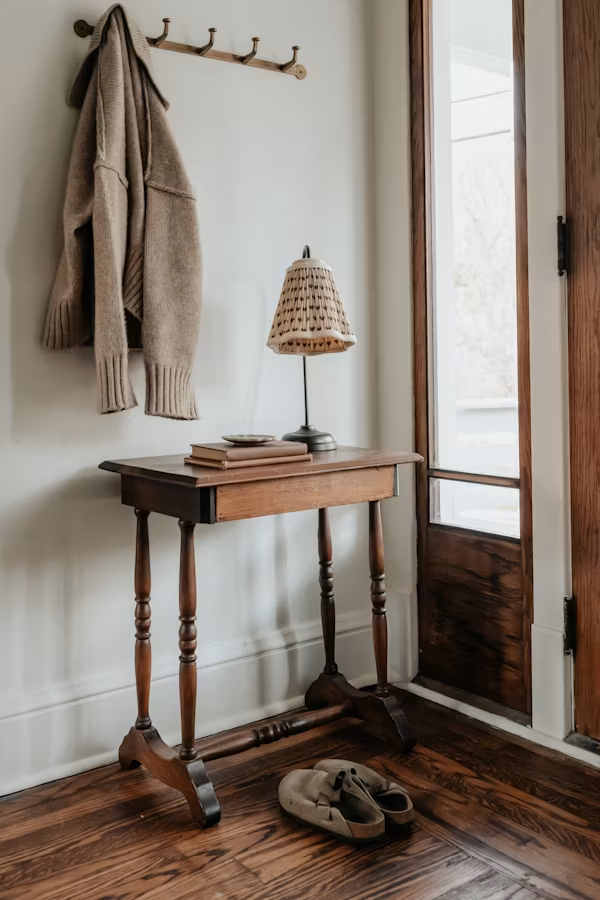
Once the structural elements are in place like the console table, the lighting, the floor, the storage, the entryway becomes the sum of its smaller choices. The paint colour on the walls, which can afford to be bolder in a small transitional space than anywhere else in the home. The art, which introduces the aesthetic language that runs through the rest of the house. The plant, which brings life to what is otherwise a purely architectural space.
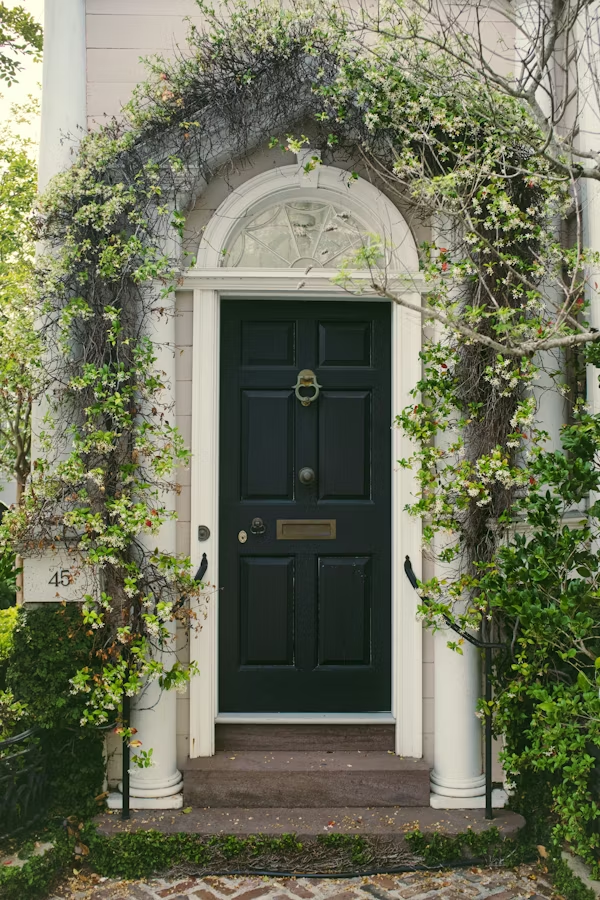
House numbers and doorbells and exterior light fixtures, visible from inside as well as out, participate in the entry experience. A hook by the door at the right height, in the right finish, positioned for actual use rather than approximate proximity to the door, these are the decisions that people don’t notice consciously but register unconsciously as evidence of care.
The mirror deserves particular attention in any entryway. Beyond its practical function, a well-placed mirror expands the perceived space, doubles the natural light from any window nearby, and creates a moment of reflection, literal and perhaps otherwise before the day begins or ends. An entryway without a mirror is an entryway that hasn’t fully considered what it’s for.
The Case for Taking It Seriously
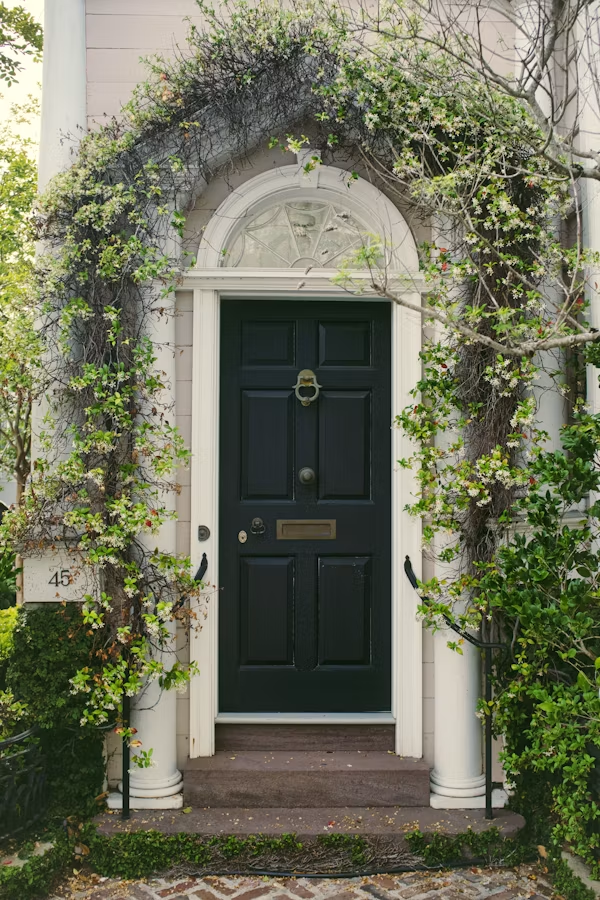
There is a reason that every real estate agent in the world talks about first impressions, and that reason is not marketing. It is psychology. Humans form rapid, largely accurate assessments of spaces in the first moments of entering them, and those assessments shape the entire subsequent experience.
Your entryway is speaking the moment the door opens. The question is only whether it’s saying something you intended or something you settled for.
A front entryway designed with genuine attention to proportion, to light, to the balance of function and atmosphere tells a coherent story about the home it introduces. It says that the people here make choices, that the space was considered, that arriving is the beginning of something worth arriving to.
That is, ultimately, what the best front entryways do. They make coming home feel like the right thing to do.
Which, at the end of any given day, is no small thing.